

She’d tried for two years to get answers from her regular doctor. She was turned away. She was told her labs were normal. She was put on birth control for symptoms that had nothing to do with contraception. Finally, out of desperation, she signed up for one of the mail-order hormone services she’d seen advertised.
A package arrived. She started taking what was sent. She felt a little better. Not a lot. Just enough to keep going.
Six months later, she still wasn’t sleeping through the night. Her energy was inconsistent. She didn’t know if what she was taking was working, or whether the dose was right, or whether there was something else going on that nobody had looked at.
This is the gap that online hormone services are filling, and why they’re also failing to fill it completely. The need is real. The solution is incomplete.
Why Women Turn to Online Services
The appeal of mail-order hormone services is easy to understand. Conventional medicine has failed a substantial portion of perimenopausal and menopausal women. Providers tell them their labs are normal. Providers tell them hormones aren’t worth testing. Providers offer birth control as a solution to symptoms that have nothing to do with contraception.
Faced with that wall, women look for any other door. Online services promise bioidentical hormones, delivered to your door, without the fight. For a woman who’s been dismissed repeatedly, that promise is genuinely appealing.
It’s not wrong to want access. The problem is that access without individualization is a form of guessing.
What Online Services Actually Provide
Most online hormone services work on a relatively standard model. You fill out a questionnaire describing your symptoms. Sometimes you do a basic blood test. Based on that information, a provider (often working remotely, often briefly) sends a standardized or lightly customized compounded hormone formula.
What that model lacks is depth. A questionnaire captures surface information. It doesn’t capture a woman’s full medication list, her supplement regimen, her gut health history, her thyroid status, her adrenal function, her DHEA levels, or the specific way her body metabolizes estrogen. These aren’t trivial details. They’re the difference between a protocol that genuinely helps and one that partially helps, or one that creates new imbalances while addressing the original complaint.
The providers on the other end of these platforms are often checking boxes. They don’t know this woman. They’ve never sat with her for an hour reviewing her labs and asking about every symptom in context. The care is technically delivered. It’s not individualized.
The Specific Risks of a Cookie-Cutter Dose
Hormones are not neutral supplements. They’re biologically potent compounds that interact with every major body system. Getting the dose wrong matters.
Consider the estrogen-progesterone balance. A woman given estrogen without adequate progesterone to balance it can develop estrogen dominance symptoms: heavier periods, breast tenderness, mood instability, water retention. She might feel worse on the hormones than she did without them, and assume that her body just doesn’t do well with HRT.
Or consider testosterone. For women, testosterone is valuable for energy, mental clarity, libido, and muscle tone. But it needs to be dosed appropriately, and it needs to be considered in the context of estrogen levels. In a postmenopausal woman with low estrogen, giving testosterone without also addressing estrogen can produce androgenic effects, not because testosterone is dangerous, but because the balance isn’t right. A provider who knows this patient’s full hormonal picture catches that before it happens. A mail-order formula doesn’t.
The same logic applies to delivery method. Transdermal estrogen carries a significantly better safety profile than oral estrogen because it bypasses the liver’s first-pass metabolism. This affects blood clot risk specifically. Does the online service explain this? Does it ask about the woman’s cardiovascular history? Does it ensure she’s receiving the delivery method appropriate for her?
Some do. Many don’t.
The Medication and Supplement Review Gap
One of the most important parts of starting hormone therapy is a thorough review of everything else the woman is taking.
Certain supplements affect hormone metabolism. Certain medications interact with estrogen or progesterone. St. John’s Wort, a common supplement for mood, significantly affects hormone processing in the liver. SSRIs interact with estrogen metabolism. Some common medications elevate sex hormone binding globulin, which can affect how much testosterone the body can actually use.
An online service has no way to conduct this review properly through a questionnaire. A provider seeing a woman in a thorough initial visit, reviewing her labs and her full medication and supplement list, catches these interactions before prescribing.
This isn’t a hypothetical concern. Women taking online hormone services while also taking supplements or medications they didn’t think to mention on a form are potentially creating interactions that explain why the hormones “aren’t working” or are producing unexpected effects.
The Hormonal Triangle Problem
Hormones don’t exist in silos. The thyroid, adrenal glands, and sex hormones function as an interconnected system.
A woman with undiagnosed thyroid dysfunction may find that no amount of estrogen optimization fully resolves her fatigue or brain fog, because the thyroid is suppressing her metabolic rate and cognitive function regardless. An online hormone service focused on sex hormones won’t catch a thyroid problem.
A woman with significant cortisol dysregulation from chronic stress may find that her hormones never quite stabilize, because chronically elevated cortisol interferes with both estrogen signaling and thyroid function. A questionnaire won’t reveal years of sustained cortisol disruption.
The gut microbiome matters too. The estrobolome, a subset of gut bacteria responsible for estrogen metabolism, determines whether estrogen is properly eliminated or recirculated. Poor gut health can drive estrogen dominance symptoms even when the prescribed dose is appropriate. An online service has no view into gut health.
Treating the whole system requires knowing the whole system. That knowledge can’t come from a form.
What Individualized Care Actually Involves
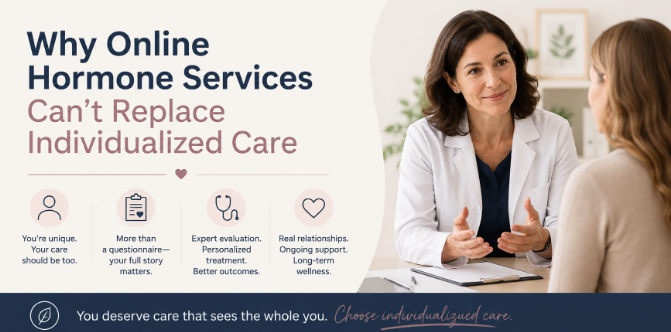
An hour with a provider, after a comprehensive panel has been reviewed, is a fundamentally different experience from an online intake.
The provider knows what your estradiol, progesterone, and testosterone levels are. They know your SHBG (sex hormone binding globulin), which affects how much hormone your body can actually use. They know your thyroid status across a full panel, not just TSH. They know your cortisol and DHEA levels. They’ve asked about your sleep, your stress, your gut history, your mood, your cycle, your exercise, your diet.
From all of that, they make a decision about what to prescribe, at what dose, in what form, combined with what else. And then they follow up. Labs at ten weeks. Visit at twelve weeks. Ongoing quarterly monitoring. Adjustments as your body responds.
That’s what “so individualized” means in practice. It’s not a marketing claim. It’s the clinical reality of what good hormone therapy requires.
For Women Who Have Tried Online Services
If an online hormone service has helped you somewhat, that’s worth acknowledging. It confirms that the hormonal approach is the right direction. What it can’t confirm is whether you’re at the right dose, using the right formulation, and treating the full picture.
If you’re still struggling with sleep, mood, weight, or brain fog despite months on a mail-order protocol, those remaining symptoms are a signal. Not that hormones are wrong for you. That the protocol may need refinement, or that something else in the picture hasn’t been addressed.
Working with a provider who can evaluate the full hormonal triangle, review your current regimen, order a Dutch test to see what’s happening at the tissue level, and then make informed adjustments, is a different quality of care than what an online service can provide.
The women who feel genuinely transformed by hormone therapy are typically the ones whose treatment was thoughtfully individualized and carefully monitored. That transformation is available. It just requires more than a questionnaire.
About the Author: Dr. Sasha Rose is a naturopathic physician and licensed acupuncturist at Med Matrix, a functional medicine clinic in South Portland, Maine. She specializes in women’s hormone health, bioidentical hormone therapy, and root-cause approaches to perimenopause and menopause.